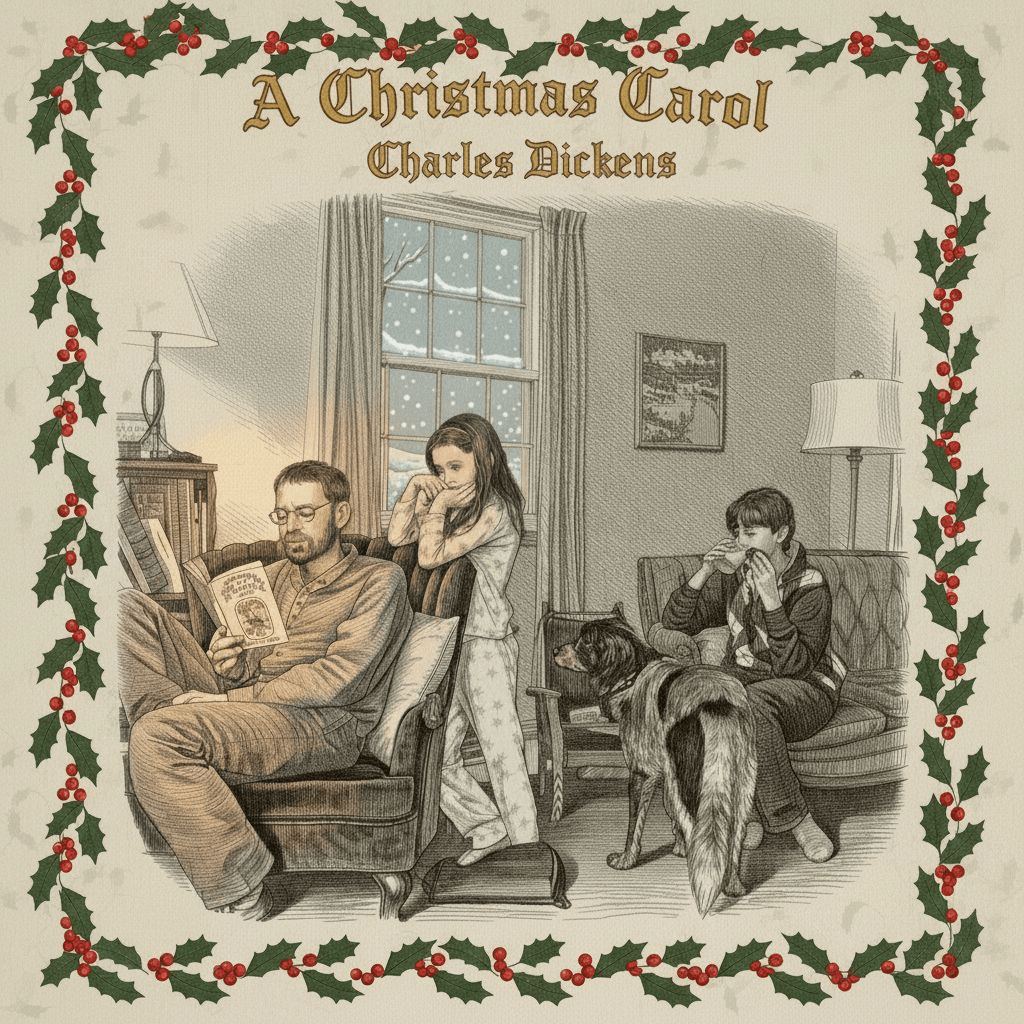
I came late to A Christmas Carol, so it seems strange to me that I can’t remember the first time I read it. While there were plenty of books around my house when I was growing up there was not a lot of Dickens. I was aware of Scrooge as an avatar of greed (my first Scrooge would have been Scrooge McDuck), but had no familiarity with the ghosts who haunted him, or of his reclamation.
When I think of the Christmases of my childhood, stories do not play a large part. There was music (popular collections from the 1960s and ‘70s) and games (Probe, Masterpiece, Mille Bourne and backgammon were perennial favourites) and food (turkey and cookies and trifle). There were some Christmas specials on television — Charlie Brown, the Grinch, Rudolph, Kris Kringle — but none of them featured Ebenezer Scrooge.
It was likely some time in my late teens or early 20s that I first read A Christmas Carol. At that age I turned my attention to reading classic literature. On my shelves still from that time are compendiums of the works of Orwell, Twain, Poe and Wells. The complete works of Charles Dickens would join them later.
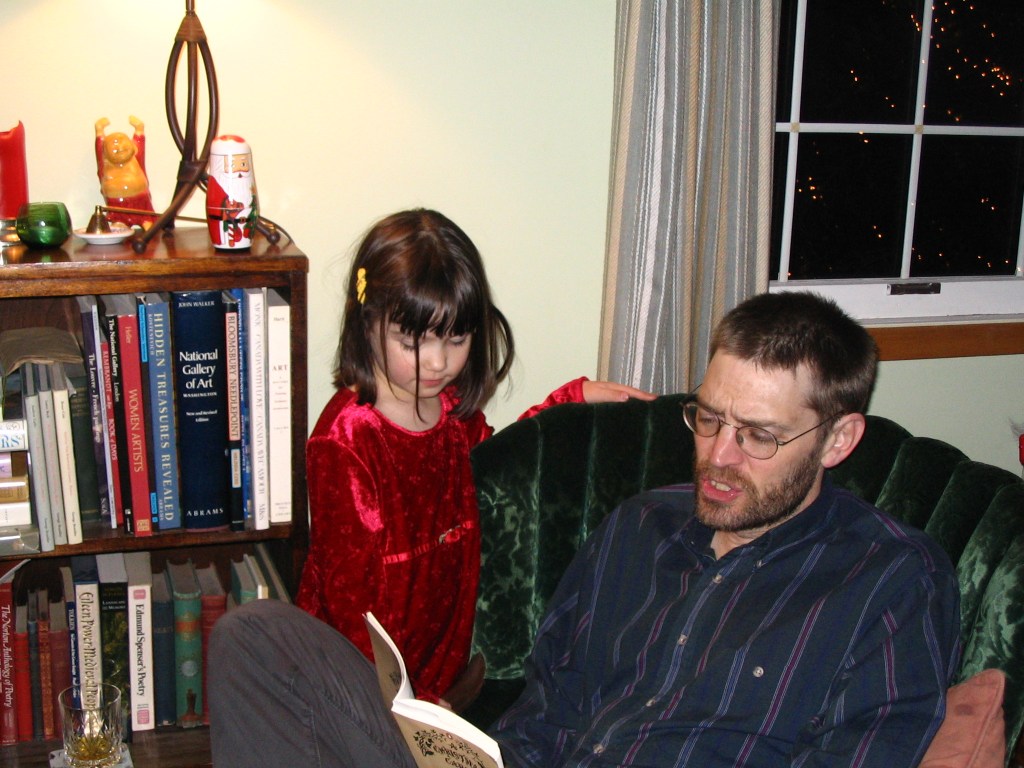
Stories did play a large part in our children’s lives, in particular, the reading aloud of stories, starting with simple books: Goodnight Moon, The Cat in the Hat, Madeline. But we took the habit far beyond that. It still surprises me to remember I read aloud the entirety of The Lord of the Rings (even the songs), and most of the Harry Potter series, up until the point that my son William couldn’t wait for me to read in the evenings and started reading ahead.
And there is still in the basement an overflowing box of books that came out at Christmas time: The Special Gifts, Olive the Other Reindeer, Space Elf Sam, and of course Raymond Briggs.
I think I was partly inspired to continue reading aloud, long after my children could read on their own, by Alan Maitland, a host on CBC Radio’s As It Happens. Come December, as far back as the 1980s and even further as far as I know, part of that current affairs show would be turned over to Maitland’s reading of Christmas stories. His reading of “The Shepherd” is still played on the last show before Christmas, and in our own house in December a vinyl record of his reading of a number of other Christmas stories will find the turntable.
Alan Maitland helped me understand that reading a story to someone, or having it read to you, is fundamentally different from reading on your own, because it is something you do together.
And so once upon a time — of all the good days in the year at Christmas time — I decided I would endeavour to read aloud the whole of A Christmas Carol. I would start on December 1, the first day of Advent, and continue on those evenings we could when we were all together, finishing on Christmas Eve.
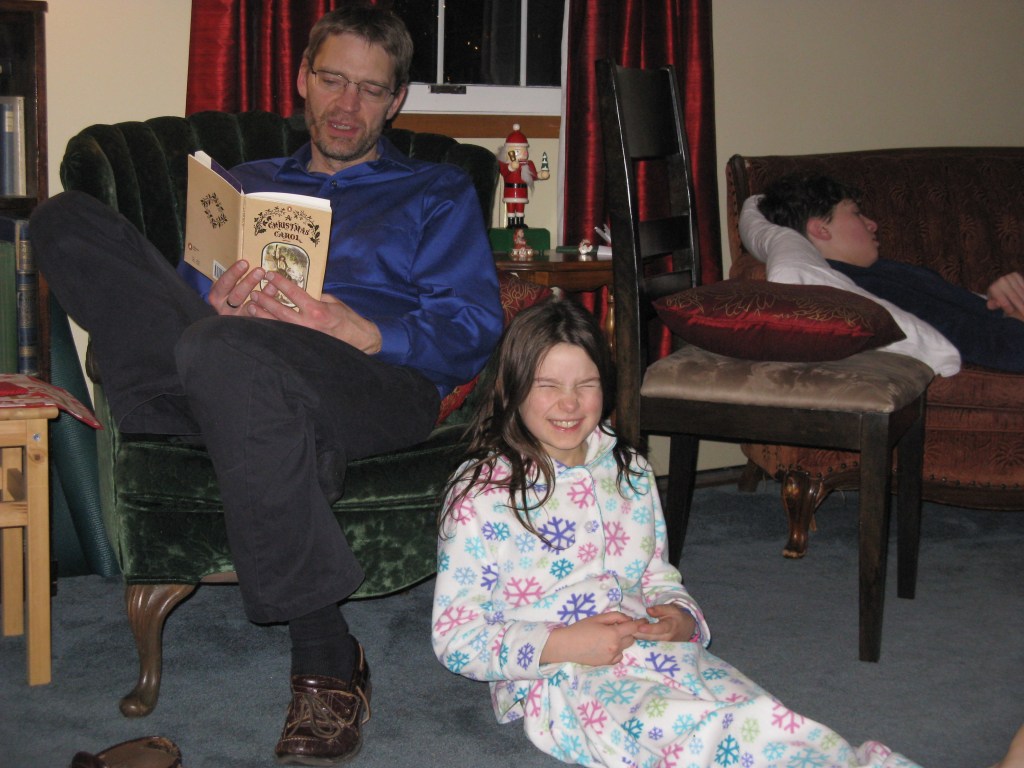
I am not certain when this started, but there is a picture of me reading it in 2006, when Ellen was just five years old. It is possible I started before this, but I don’t think it is likely. We did not always manage to get everyone together to start December 1 and we did not manage to always finish by Christmas Eve. In latter years we gave ourselves some leeway. In our house the decorations stay up until Epiphany, giving us until January 6 to finish.
This carried on for about a decade, until the children developed other interests in December.
But why A Christmas Carol? Again, my memory is fuzzy on this.
By 2006 I had not only read the book but seen the 1951 Alastair Sim movie, and my children would have seen the Muppets version from 1992 in more than one Christmas season.
But I do have to suppose the book did not initially make a huge impression on me, given that I can’t remember when I first read it. If the Ghost of Christmas Past came to me now and, as he did not do with Scrooge, allowed me to pass some advice onto my younger self, I might suggest paying closer attention. I might, currently, make the same suggestion for everyone.
So much of what we take for granted today is contained in this book, of Christmas “as a good time; a kind, forgiving, charitable, pleasant time,” a time that “from the numbers of people on their way to friendly gatherings, you might have thought that no one was at home to give them welcome when they got there, instead of every house expecting company,” and that it is “a shame to quarrel upon Christmas Day.”
All these things, along with “holly, mistletoe, red berries, ivy, turkeys, geese, game, poultry, brawn, meat, pigs, sausages, oysters, pies, puddings, fruit, and punch,” (though brawn seems to have gone the way of cold boiled) Dickens can claim to have helped rescue for the holiday season.
And then there is the story itself. What is that about?
Society commits a grave injustice in casting Scrooge as an avatar of greed, paying no attention to the man he became thanks to the intervention of the ghost of Jacob Marley and the three Christmas spirits. We all love a villain, and it seems Scrooge is too good a one for us to let go of.
But the error is graver still when you realize the story is not really about Scrooge at all, but about society as a whole. Scrooge is not just an avatar of greed. He is an avatar for all people who believe ““It’s enough for a man to understand his own business, and not to interfere with other people’s,” and who don’t understand “The common welfare was my business; charity, mercy, forbearance, and benevolence, were, all, my business.”
Christmas is more than just a joyous celebration. It is hope itself. Hope for a change in the world, starting with just one day.
It may be that Dickens foresaw that Scrooge’s villainy was perhaps too appealing. As he notes at the end of the book, “Some people laughed to see the alteration in him,” and he adds a further admonition, “such as these would be blind anyway.”
And so I urge you, as you listen, to pay less attention to the man Scrooge was, and more to the man he became.
“He knew how to keep Christmas well, if any man alive possessed the knowledge. May that be truly said of us, and all of us!”
Audio produced by Will Yarr
If you enjoyed this reading of A Christmas Carol, consider making a donation to the Upper Room Food Bank in Charlottetown. Tell them Uncle Scrooge sent you.

